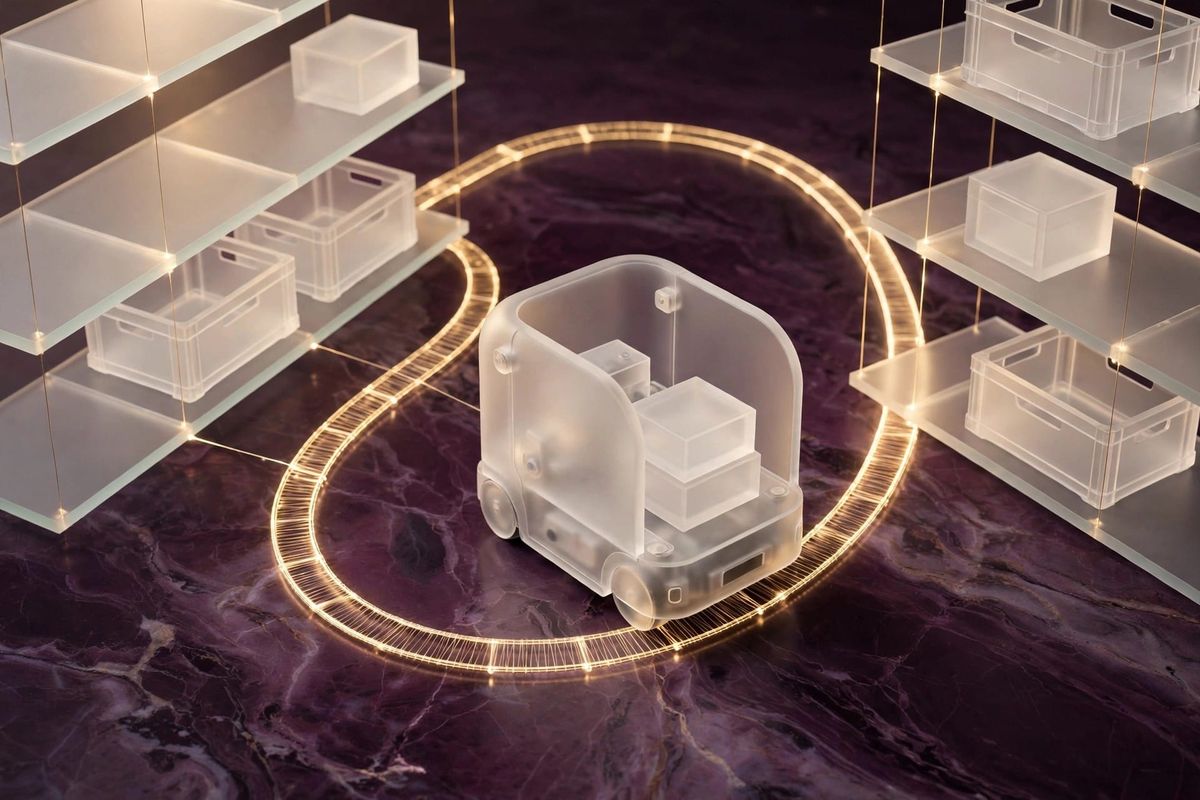
Intel and SAP show business software directing warehouse robots
The Live Wire · Published
TechnologyThe business software now tells the robot what to do, and the robot reports back. The question is who stays in charge of the work.
On October 27, 2026, Intel and SAP announced a physical AI collaboration in which warehouse transport tasks generated in SAP Extended Warehouse Management are automatically translated into robot missions and executed autonomously, demonstrated in a proof of concept at Intel's Chengdu site in China.
That closed loop is the story, not just the robot. SAP provides the business context, workflow governance, and process orchestration. Intel provides edge AI and robotics hardware and software. A task starts in the business system, becomes a robot mission, and the outcome flows back into SAP as structured data. SAP says that loop reduced transport distances and repetitive manual handling at Chengdu.
For warehouse teams, the possibility goes beyond moving goods faster. Repetitive handling takes a toll on the body. If machines take on more of that work, what could people be prepared to do next? Guiding the systems, noticing when something goes wrong, and making decisions that keep the work moving are skills worth developing alongside the technology.
Tech Equity
What I will be watching here is simpler than a rule for a business. It is the same question I ask of any technology: what does this support and empower a person to do?
In this case, a system that starts a task, carries it out, and reports back with a clear record is interesting because it can take repetitive transport work off a person's body and put that person in a place where they are watching the work, catching exceptions, and using judgment. If that is what actually happens at Chengdu, and if repetitive manual handling really goes down, then this is a good example of technology fitting the person, not the person fitting the machine.
For people looking at where work is going, this is worth thinking about. In this hybrid digital world we are in, this hybrid setup, a skill that could be valuable to have, and could make a person more hireable, is learning how to guide, direct, and supervise machinery, not just how to work a machine, but how to work the systems around the machine.
Machines are being produced at record speeds. What could that mean for training? Training people on the supervision of these processes, what that looks like, noticing when something breaks down, and how to engage so we do not lose the flow of work. Nothing beats a human mind.
I really want to see vocational rehab programs start to look more at this: how do they monitor the technology that is in place? How do they train a person to guide it, direct it, and supervise it, so the person stays in the loop? That is a question worth sitting with, not a definite answer, and it is the kind of direction employment readiness could take, if we are serious about people working alongside machines, not just under them.
That is the value to notice as this moves from a proof of concept to a real warehouse.
Source: SAP News Center, SAP Unveils Physical AI at SAP TechEd in 2026, published October 27, 2026: https://news.sap.com/2026/10/sap-unveils-physical-ai-extends-autonomous-enterprise-real-world-sap-teched/