A Johns Hopkins robot adjusts its cuts on kidney models, with human oversight
Precious “Preciosa” Myers-Brown · Published
TechnologyEight model procedures show progress in tracking changing tissue, not a system ready to operate on people.
A research team including Johns Hopkins engineers has demonstrated a supervised robotic system that updates its understanding of a kidney model as it cuts. That ability to adjust matters because soft material changes shape during a procedure. A plan made before the first cut may no longer fit what is in front of the robot.
In the team's research paper, the system performed eight tumor-removal procedures on hydrogel kidney models, making 77 electrosurgical cuts. The researchers report negative margins in all eight resections, meaning the cuts stayed outside the model tumor boundaries. These were laboratory models derived from patient imaging, not operations on people.
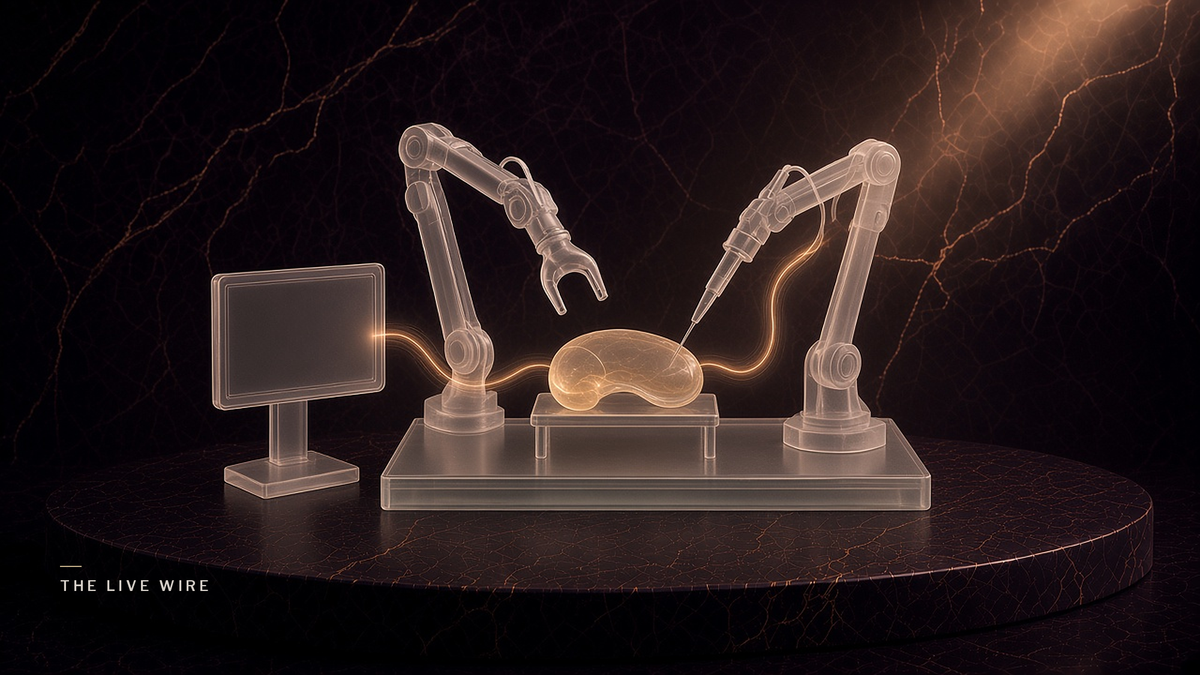
The setup pairs a camera with two robotic arms, one for cutting and one for holding tissue with a vacuum gripper. It uses simulation-trained models to track anatomy as the material changes. Human oversight remained part of the work: supervisors requested re-planning, and three vacuum-grasp failures required manual re-engagement.
Those details make the result clearer than calling it error-free surgery. The paper also identifies important limits: the models do not bleed, the sample is small, and substantial work remains before use in living tissue or a minimally invasive setting.
Tech Equity
Robotics research is worth following when it tells us both what became possible and what people still need to do. Here, the advance is a system that can revise its plan as the scene changes, within a supervised laboratory task. The next stages should keep that transparency: what the robot handles, when a person intervenes and how safety is evaluated. That gives patients, clinicians and the public a useful way to understand progress without confusing a promising model experiment with an available treatment.
Source: Occupancy Network-Guided Autonomous Robotic Partial Nephrectomy