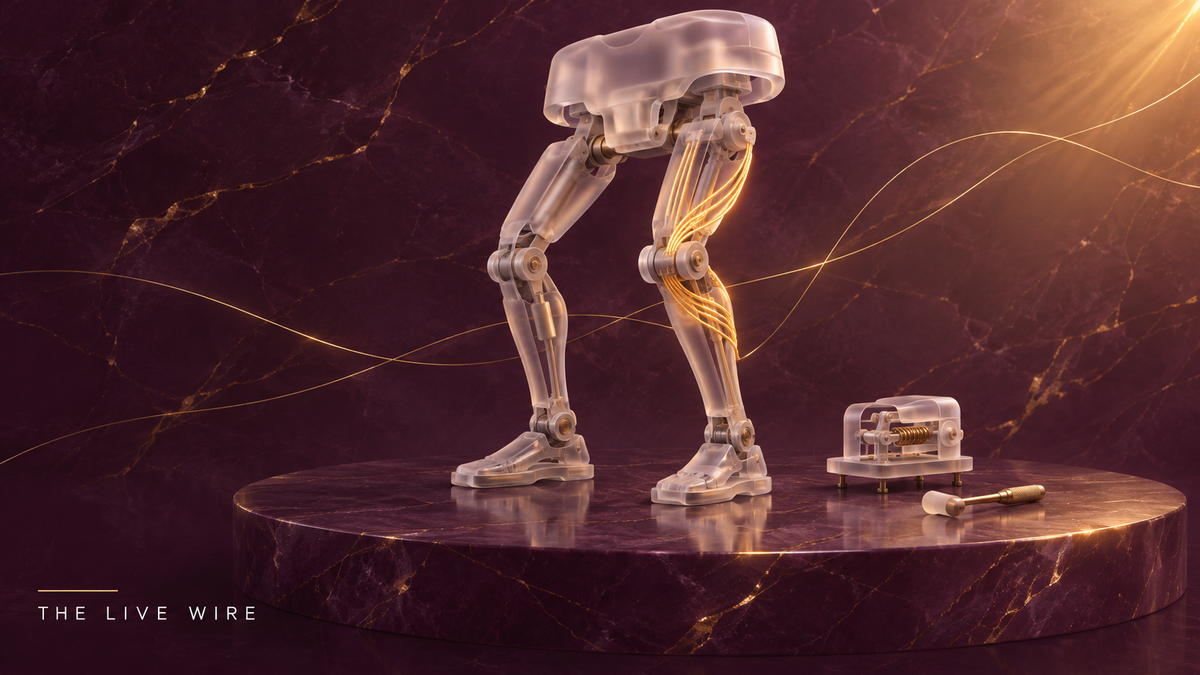
A mechanical knee reflex offers a new direction for robot movement
Precious “Preciosa” Myers-Brown · Published
TechnologyTohoku researchers reproduced a knee-jerk response without electronic sensing in the reflex module, then used it in a walking robot.
Not every response in a robot has to begin with an electronic sensor. Researchers at Tohoku University have built a mechanical reflex module that responds when an artificial muscle stretches beyond an adjustable threshold.
In the university’s November 4 report, the module automatically triggers contraction and reproduces a knee-jerk response without electronic sensors or circuits inside the module. The team also demonstrated bipedal walking, using a higher-level controller to change the reflex threshold during different phases of movement.
That distinction matters: the reflex module is electronics-free, not the entire walking system. The work, published in Advanced Intelligent Systems, explores whether combining mechanical reflexes with limited electronic control could simplify future robots. It is not an announcement of a ready-to-use prosthesis or care device.
Tech Equity
There is something useful in asking what the physical design can do before asking software to do everything. A well-designed mechanism may give engineers another way to create responsive movement, with fewer steps between a change in the environment and a reaction.
For enabling technology, the next questions are practical. Can this approach make equipment easier to maintain? How does it perform across different bodies, movements and unexpected conditions? What would it cost to build and repair?
Those benefits still need to be demonstrated. The contribution here is a new design option worth following, especially if future research brings users and the people who support and maintain their equipment into the testing process.
Sources: Tohoku University’s artificial-reflex research report.