Are We Training for Jobs That Are Disappearing?
Stores with no cashier are already here, while people with disabilities are still being trained to count coins and work a register. Why vocational rehabilitation has to train toward the jobs that will still be there, and where we start.
If we have a class of a thousand people coming through the system to be trained to do something, that's a lot of people to push out. But to where?
I show a video of me going into a store that has no employees. No employees. There's no cashier. Nobody is in the store. You pick up all your items, and you walk out. That is today. And it's still there. There are stores that do it out in the field still. Amazon says its walk-out checkout is running in more than 360 places across five countries, and in Poland, Żabka has more than 60 little stores with nobody working inside.
No cashier. No money exchange. My stuff in the bag, and the receipt on my phone.
Read the video transcript
Just walk out. Okay.
One of the reasons why we have to make sure that we upgrade our digital training with the people that we're working with, whether they'll be seniors, people with disabilities, or our general community members, is that the digital world is changing.
Not only do we not need to worry so much about paper money, I mean, paper money still exists, but we need to learn how to shop now in the current way that stores, and more importantly the digital inclusion, has adopted, and that is touchless shopping. Touchless shopping.
I want to get some water and maybe a diet soda, so I'm going to get a shopping bag.
Zero. You know I don't do sugar. Okay. So we have our items here.
Follow me, please.
So, all we're going to do is tap. I'm going to get my receipt. But that's totally optional. And then we just walk out.
No cashier. No money exchange. Just, clearly, my stuff in the bag. The technology already saw me get everything, put it in the bag, rang up my receipt, and it's now on my phone.
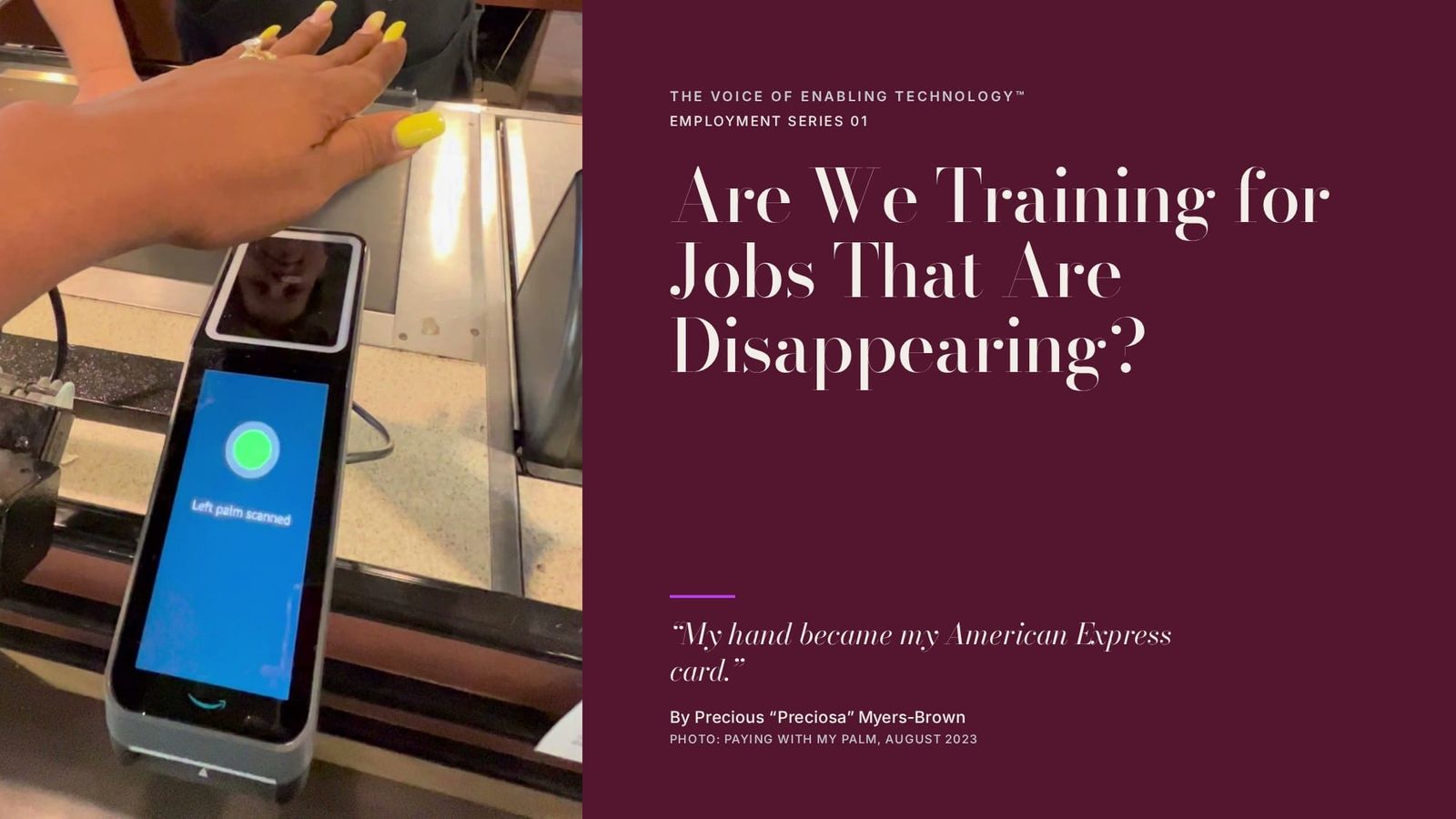
The other video that I recorded myself doing was using my hand, the palm of my hand, to pay for food, so my hand became my credit card. My hand became my American Express card.
My hand became my American Express card.
But yet the people we support are being trained on identifying coins, and counting. The goal is grocery shopping and identifying coins. The majority of us walking around don't even have coins. The majority of people are paying by credit card, and after that, tap pay. If somebody's goals are only that they learn coins, how do they learn how to shop in a modern today?
We train people to learn money and learn how to shop with a cashier, and we are even training people to become cashiers or to work at a checkout counter. We're training people to do a job that appears to be disappearing.
There are a number of things happening outside of the grocery stores or the shopping centers as well, including the shopping cart. Yes, people. The same Instacart that you order your groceries from actually has created smart shopping carts. That's big. It put carts that ring you up while you shop into Kroger and Wegmans in the United States, Coles in Australia and Morrisons in England, and this fall Instacart said it's winding its carts down. At the same time, Amazon is scaling its Dash Carts up, into dozens of Whole Foods stores by the end of this year.
How about the robot that goes and collects all the shopping carts and brings them back to the store? That used to be a job for people, right? Right now it's usually one worker with a remote, walking next to a machine that pushes up to 30 carts back at once. Walmart even has patents for carts that drive themselves back.
And Amazon pulled its own big grocery stores this year. Being able to monitor a 40,000-square-foot footprint may have been too much right this second. It doesn't matter if they open or close. Testing it at that scale taught Amazon that it has something that works in smaller stores, so it's licensing the technology to other businesses. Anybody who has been through an airport may have walked out of a Hudson Nonstop with no line. It's in sports stadiums, hotels and other travel venues.
Amazon ended its palm payments this June. The idea is not to focus on the fact that Amazon pulled out. If everybody pulled out, then I would say, okay, it's a moot point, we're not going there. But it's not. It's proof. When Amazon pulled out, the most interesting part to me was what happened next. JPMorgan Chase has been piloting face and palm payments with PopID and preparing a national rollout, and PopID is also the technology behind the United Arab Emirates' new biometric payment system. Mastercard has its own biometric checkout program. Verifone, whose payment devices are at checkouts everywhere, is scaling face and palm vein scanning into mainstream retail. What Amazon learned, to me, is that it's difficult to build something from scratch and make everybody come to you to use it. What Amazon has done very well over time is be a marketplace for others. It built something, and now everybody else is taking it to the next level, and everybody can integrate it. That's what's telling.
What's working and what's not working is an easily understood framework in the field of disability services. I see the tech vendors in that same space: testing and trying it out, and learning from what works and what doesn't. What is clear is that the pieces that do work are being scaled. So training people to work at a stadium, a hotel or an airport has to include training on how to use the technology that's there. The solution includes some form of technology that we need to help people embrace. It's never going backwards, but we can teach people how to move forward with it.
It's November 2026
Sometimes we say AI is taking people's jobs. It's true and not true. The digital evolution has us utilizing AI more, so the traditional roles and jobs are being reduced. Robotics is being utilized more. And I'm baffled, because with all this digital evolution, people without disabilities are losing their jobs and don't have the skill set to shift quickly into the jobs the future is heading toward.
Through October, employers pointed to AI as the reason for 121,401 job cuts this year. That's more than double all of last year.
Visually, I see a major shift in the labor market. Automation, robotics and the future of work have all run into each other. So what does the future of work look like for people with intellectual and developmental disabilities, for migrant workers, for entry-level workers? Where we have arrived is a real challenge, and it's a pivot point for what we mean by workforce development for people with disabilities, and for any of us.
In vocational rehabilitation, it's not uncommon to hear, or to see in the data, that customized employment has historically been built around predictable task jobs, the same jobs that are now being done, or targeted to be done, by automation. You can see it in the national records. From 2017 to 2020, when people left vocational rehabilitation with a supported or customized job, food prep was the biggest group every year, and the top two jobs were stock clerk and janitor. Supported employment paid about $10.39 an hour, for about 22 hours a week. Those are the entry-level positions that historically gave us what we call in supported employment low-barrier employment: stock clerks, backroom inventory sorting and stock management, janitorial, environmental services and food prep.
Now put that next to where those jobs are going. The federal ten-year outlook released in August projects cashiers to lose more jobs than any other occupation in the country, about 200,600 by 2035. It still shows growth in stocking and cleaning, but the largest warehouse employer in the country is planning around the people it will not hire. Amazon passed one million robots last year, and internal plans reported by The New York Times aim to avoid hiring about 600,000 workers by 2033. I'm not talking about humanoids for everybody, but there are robotic stockers already. Machines can do it on their own.
I am watching it happen. Autonomous mobile robots in retail backrooms. A restaurant in my community, a real restaurant and not a cheap one either, with robotic servers bringing the food to the table. Automatic floor scrubbers. Disinfecting robots. Food delivery robots. Robots delivering prescriptions in hospitals. And of course, frictionless grab-and-go where there used to be a cashier or an attendant. From my perspective in tech equity and enabling technology, as robotics absorb routine physical tasks, there are some tasks I'm even excited about, because the technology helps me in my daily life.
I remember being in the United Airlines lounge at the airport, watching a robot bus the tables. It went around to each table and asked people to put their trays on it. This might have been 2022 or 2023. I immediately thought about the people who, in a previous role of mine, were being trained on how to bus tables. I remember saying to myself, "Oh my God. Look at this. Somebody I know is being trained right now on how to bus tables, and I just watched this robot bus all of the tables." I've seen robots at CES cook food, wash dishes and do all the different things we are training people to do.
A lot of people, maybe 10 years ago, would say, "No, I would never get in a driverless car." Here they are in a Tesla, or in a Waymo. I knew that driverless cars could be a thing the minute we had cruise control. A lot of people say, "I will never use tap to pay," but yet a lot of us tap to pay. A lot of people say, "I would never transfer money by way of phone to phone," but here we are with Cash App and Apple Cash. A lot of people say they don't trust AI but are using agents such as Grokbots, Meta Muse, Claude and ChatGPT to do a lot of things for them. These are things that we're able to look at and find the writing on the wall.
Every year I attend CES, and it's one of my favorite highlights of the beginning of the year. When I'm in Eureka Park and in some of the concept areas, CES has proved to me that everything I imagined in my head as a child, that might have been called hallucinatory or child's play or imaginary play, really does exist in some way, shape, or form. It may not have made it out to the modern market or to the consumer end of things yet, but just the fact that there's somebody with a booth in Eureka Park showing you this thing that could happen lets you know that it's real, and it's on the way to happening.
I remember the first time I saw WHILL, a Japanese maker of autonomous wheelchairs, at CES, and I was like, that's so cool, because anytime I see technology, I always think about how it could enable someone who has a disability or has some barriers to live the life that they want to live. They were making them for airports at the time. Immediately when I saw it, I said, no, no, no. Oh my God. Think about Miss So-and-so, who loves to go to the corner store, but she has problems driving her power wheelchair. Let's put the coordinates to the corner store in the wheelchair and let her go.
I had that conversation right there with one of their reps, and he was like, oh my God, that's really good, but his whole focus at that time was only on airports. I get it, and it makes sense. I'm a traveler, and I want a good travel experience. The person who needs to get from gate to gate with some physical limitations needs a great travel experience too. But I came back and told my team in residential and all the different home and community-based services: this is where it's going, and this is how it could be used.
Next thing you know, years later, I'm transferring through Miami airport, going back and forth to Bogotá, Colombia, rushing to get to my gate. Lo and behold, I hear beep, beep, beep, like a chime, and behind me is that freaking wheelchair. The autonomous wheelchair I had seen years before at CES is now in Miami, empty, going to pick up its next passenger. I keep walking, and then I see a whole school of autonomous wheelchairs headed to their gates, with a little tablet on the arm of each chair showing the name of the person it's picking up and which gate. That is what I'm talking about, people.
It's not something people are ordering under their durable medical equipment state plan yet, but it will be. Just like the driverless cars, some people will have their own version in their wheelchair. The Waymo wheelchair. Look at that. Did I just give Waymo an idea? Waymo, just so you know, if you take it, that's an invoice coming from me.
So I start thinking about, okay, what are we training people to be or do? What does it mean for people who are being trained to work in warehouse jobs? What does it mean for people who are trained to be assistants on transportation, or assistants in classrooms? We have to look at the outcomes. How do the training outcomes equal them having a job in an AI-assisted world?
I can ask right now: what kind of jobs are out there? They might tell me Walmart. And if that warehouse automates, what does that mean? I get a job for three months, and then what? Now I'm back. Am I coming back through intake? Or what? What happens there?
If we have a class of, let's just say, a thousand people coming through the system to be trained to do something, that's a lot of people to push out. But to where?
Gainfully employed, just like anybody else
I'm concerned about what vocational rehabilitation looks like. We have to be able to pinpoint what jobs, or what things, we can start creating, and how we should be aligning vocational rehabilitation so that people with disabilities can be gainfully employed, and so that we're not wasting money training them to do jobs that are clearly not going to be the majority of the jobs that have traditionally been out there. It requires a futurist mindset.
When the teacher becomes the guide
Here's a clear example of what I mean. There's a school called Alpha School. It started in Austin, and this September it opened in Chicago. The kids get through their core academics on software in about two hours a day, and the adults in the room are there to mentor and coach them. The students call their teachers "my guide."
And what that does is, if the teacher is no longer the teacher, and the AI is the teacher, and the person in the classroom becomes the guide, it changes the qualifications for a teacher. The teacher no longer has to be the subject matter expert in the room, nor do we have to wait on the limitations of that teacher to know how to teach different students. The AI is spitting out an individualized education plan and curriculum for that student. We're not talking about an individualized education program track. We're talking about everybody being taught based on the way that they engage with the AI.
So the person who is being trained to be in a classroom just needs to be trained on how to coach people and be an assistant to the AI. That means the credentials, the qualifications, open up for more people who are trained on how to work with people and how to work with AI. It opens it up for people who didn't qualify to be teachers before. People who we would normally support in the services we offer can now be trained to coach and facilitate, to be that guide, if the right training program provides the resources. The average person who does not have a degree in anything, but is a great coach and a great facilitator, can take that role of guide.
The trajectory is that we should be training, and we should be training ourselves, and we should be training others, on jobs that work with AI, not the jobs we traditionally had.
Do the people guiding people even know?
The first step in literacy is understanding where we are at, what's going on, and what is what. And especially on the workers' side, meaning your rehab counselors, your job coaches, your vocational liaisons. Do they even know? Because they are the ones assessing and guiding and determining, helping people figure out what's what. Do they even know what's happening in the current job market in our area?
I think about when I was job coaching. All the time I used to spend on a resume, now I'll give it thirty minutes, tops. Not hours and hours and hours. The more information you can get, the easier the AI can produce the basic infrastructure for the first meeting and beyond. The resume can be spun up, and then you fill in the blanks. That's where the human comes in and says, okay, let's explore what other things you've had, to fill in those blanks. Then use AI to match: you have all these backgrounds, these are the things you like to do, let's see if we can match it with potential employers. That takes three minutes. And it gets very person-centered.
And teach people how to prompt AI to help them understand what the job market looks like right now where they live, not what a data report from years ago says.
Even for our own selves, honestly. We've always been at will, right? But it's more about what skill set you are maintaining that keeps you marketable in an evolving situation. So for our staff, and for the people we are supporting, both need to be happening pretty quickly, at the same time. Not focused on whether you're about to be out of a job, but focused on how to use technology to at least create some beginning systems for yourself.
The community is digital now
We should use Employment First as the framework for how we look at what people do with their day. Even if they never get the job, we still must consider it.
It's 2026. The community is not just a physical community. We are in a hybrid of physical and digital. So that means we should be helping people be included in that community, and if we only focus on the physical community and only focus on traditional ways, we have not done our job. The Home and Community-Based Services settings rule said that everybody must have a key to their environment. Where's their key to the digital environment? That's what I call the Digital Key.
Where we start
Literacy first, for everybody at the table. Every person who walks through the vocational rehabilitation door should leave with basic AI literacy. Every counselor, job coach and vocational liaison should get it first, because you cannot guide somebody through a job market you have not looked at yourself.
This cannot be a one person does it this way, and another person does it that way. We all must unhinge from the way we used to do it and think about how we transfer, transition, and evolve that into something that has creativity and evolution as part of its framework. You can't have agencies and providers that are still working on paper expected to be able to support people to become gainfully employed in this ever-evolving future that we're living in. The two cannot exist.
I'm not saying we don't need a library of papers to show, like a museum. I love a good museum. What I'm saying is that we have to move forward. Every member of the team should be engaging this way. Our operations should engage that way, so it becomes not a thing we just talk about, but something we're about.
When I'm doing my trainings, I say the invention of electricity doesn't mean that we should not have stocks of candles. Sometimes we have power outages, and when we do, we use candles and battery-operated flashlights. Just because we have USB chargers doesn't mean we shouldn't have our collection of D batteries, AAA batteries and AA batteries. We still need both. But in the majority, we don't operate on everything being battery.
Train toward the jobs that are growing, and the parts of jobs AI cannot carry. The same federal outlook that shows cashiers shrinking shows home health and personal care aides adding about 847,300 jobs by 2035, more than any other occupation. Add the guide roles, the checking roles and the technician tracks the robots are creating, and you have a training list that looks forward.
When we start training toward jobs that are growing, we will always have a need for humans. How we utilize our skills may be different, but as we are all hoping to age, there will always be a need. My whole entire time in the human service field, there has always been a workforce crisis. When I was a direct support professional, I could always work multiple shifts. If we've always had a shortage of workers, and we are evolving into utilizing more technology in how we do our work, then we need to start training people to do the hybrid of the work that includes technology as a solution for care, and that includes the knowledge of being a human service professional, so that we don't create another workforce crisis in the future.
We need to teach people how to monitor and operate the technology. Instead of competing against the automation, we need to train people to work with it: run the inventory software, manage the kiosks, supervise the robots. In some of the grab-and-go stores, I've seen one worker who is there when people are having problems, in a store I frequent that maybe had 20 workers before. The person who gets that job is the one who knows how to guide the customers through the automated process, or how to restart the equipment when it's not working right. Vocational advocates, business leaders, employment specialists and job coaches need to shift from traditional placement to digital and technical upskilling. We have to shift to training people to be doers, to be operators of that technology. Operators who run the technology, and guides, like the ones at Alpha School, who coach the people using it. That's what I call the Operator and Guide Model.
And if somebody asks me, what about the people who were counting coins? I'd ask, if they were counting coins, what job were they doing counting coins? If they can count coins, they have the ability to press a button, to operate the machine that does it, or to monitor it and press the button when it's not working. Regardless of somebody's disability, what we will always look for is what the person can do, and how we can use technology and resources to fill the gap, so we create a bridge to what they will be able to do. Nobody is the same.
I can admit that robots excel at repetitive, predictable, physical movements. It doesn't require much thought. They can just repeat, repeat, repeat. Where they fail, and where even some AI systems fail, is in things that require high emotional intelligence: problem-solving, flexibility and direct interpersonal care. I'm not saying they won't eventually learn, but this is where we are today. So I think we need to pivot training and workforce development toward hospitality, personalized customer experience, peer support and human services. Those are roles that are extremely difficult to code.
Trust and believe, I have a team of AI agents that work for me personally, and none of them can do what I consider requires a human. The repeated task, the scheduled task, absolutely. Following strict directions and rules, yes. Having a direct, high-intelligence, personal interaction without hyping me or just agreeing with everything I say? Not yet.
While technology may change which jobs get done by humans, or displace jobs, it definitely lowers barriers. It lowers the barriers to entry for higher-wage tasks. Because there needs to be a different skill set to facilitate, relate to, work with and support automated systems, it opens the door to people who have different skills and different ways of doing things. Plus, the technology can lower a barrier someone had before, so now they are able to engage, actually work and use their skills.
My point in bringing this up is that the old playbook for supported employment, the old playbook for employment for any of us, has transitioned. Our reliance on predictable retail and janitorial roles has hit what I call the Automated Ceiling. The tension we need to manage is in moving forward, because we have to move forward. The challenge is making sure these technologies don't shut people out. They should push us to redesign our own roles, those of us who work in this field, and to create work that pays better and is deeply human.
We have to train the workforce. I have worked in all of those positions, and that's why I had to create WATI Institute: so we start training and developing the future of care. That's what I'm intentionally building: not just enough care for the people who need it today, but a future that is already prepared for all of us who are aging into it.
Measure the training by whether the job will be there. Before a dollar goes into a training program, ask what that job looks like in three years and what the person's next step is if it changes underneath them. Twenty-two hours a week at about ten dollars an hour, in a role that is shrinking, is an outcome nobody signed up for.
Their purpose is not to be under my care
Don't people with disabilities want to be gainfully employed, just like anybody else?
Every last human being on this earth has been given a purpose. And their purpose is not to be under my care. They have something they need to offer to the world, and my job is to break down barriers, make sure that I give them situations and opportunities, and remove myself from being the only thing that allows them to experience life. I need to be in the shadow so that they can express who they are.
When we do our innovation-first transformation work with agencies, helping them move their traditional services to the future of care, we like to show them a video of Stephen Hawking. If you looked at him, most people would judge him to not be able to contribute what he did contribute. Because he had access to technology, access to solutions, and probably a support team that broke down barriers, he contributed so much to what we rely on today. That's what I mean.
Each person on this earth is a contributing member of our society. What they have to contribute, I don't know, but my job is to make sure there are no barriers for them to live their life, participate, find their purpose, live how they want to live, and reach the level of self-actualization they feel is possible. I still say I have the best job in the world, if you even want to consider what I do a job. I've been given the best purpose in the world, and it is to help people live their best life.
We got to move faster as a field. We don't have to throw away the traditional. Candles still matter when the power goes out. But we cannot run a 2026 workforce, and I'd say a 2027 workforce, on paper and spare change.
This is not my first. This is not my last. This is one of the first conversations I will be bringing to this series, because there's so much we need to talk about as a field. There are so many things we need to evolve from and unhinge from. I'm not saying the traditional was bad. It definitely was not. I love a traditional moment. What I'm saying is that we have to bring it forward. We have to bring it forward.
Next, I'll be talking about the goals that we write with and for people, and why the coins have to go.
Bring this shift to your agency. If your agency, your state system or your conference is ready to unhinge from the constructs that keep us in the Paper Era and build a future-ready workforce, let's talk. Message me on LinkedIn.
Sources
- Challenger, Gray & Christmas, October Layoffs at Three-Year Low (Nov 5, 2026)
- Challenger, Gray & Christmas, 2025 Year-End Report (Jan 8, 2026)
- Utah State University, Supported and Customized Employment Outcomes: RSA 911 2017-2020 (2022)
- Bureau of Labor Statistics, Employment Projections 2025 to 2035 (Aug 27, 2026)
- Bureau of Labor Statistics, occupations with the largest job declines
- Bureau of Labor Statistics, occupations with the most job growth
- GeekWire, Amazon's robot workforce hits 1 million (July 2025)
- Gizmodo, on The New York Times report of Amazon's automation plans (Oct 21, 2025)
- Alpha School background
- NBC Chicago, AI-driven school opens in Chicago (Sept 9, 2026)
- Grocery Dive, Instacart winds down its Caper Cart smart cart business (Oct 2026)
- RetailDetail, Instacart's smart shopping cart makes its UK debut at Morrisons (2026)
- Grocery Dive, Wegmans tests Instacart's smart carts at its Syracuse store (July 2025)
- About Amazon, the newest Dash Cart expands to dozens of Whole Foods Market stores by the end of 2026 (Jan 2026)
- Gatekeeper Systems CartManager XD, a remote-operated cart pusher that moves up to 30 carts
- Money, on Walmart's patent for carts that return themselves
- PaymentsJournal, After Retail Closures, Amazon Pivots on Just Walk Out Technology (Jan 2026)
- Aviation Pros, Hudson Nonstop arrives in Chicago using Amazon's Just Walk Out technology
- Chain Store Age, Just Walk Out now powers more than 100 stores in sports stadiums
- Just Walk Out, hotels and casinos moving to checkout-free markets, including the Omni Boston Hotel at the Seaport
- Wiadomości Handlowe, Ponad 60 sklepów Żabka Nano (Oct 28, 2026)
- Biometric Update, Amazon discontinues Amazon One palm payments for retail (Jan 2026)
- American Banker, The future of palm payments after Amazon's pullback (Feb 2026)
- ID Tech Wire, Amazon discontinues Amazon One as J.P. Morgan prepares a national rollout of palm payments (Jan 2026)
- Verifone, Verifone Biometrics: face and palm authentication on Verifone and other payment devices
- Verifone, biometric-capable payment devices with face and palm-vein verification come to Australia (Aug 13, 2026)
- WHILL at CES, January 2024, page 10
- WHILL autonomous chairs taking American Airlines customers to gates at LAX and MIA
Precious “Preciosa” Myers-Brown is The Voice of Enabling Technology™, Chief Innovation and Dream Officer™ (CINO) | CEO | Founder of Vista Supports, and the author of Tech Equity: Freedom Through Enabling Technology. She started as a direct support professional over three decades ago, and in 2006 she created the first smart home and remote support solution in the DMV.