AI Flattened My Voice. Now Imagine What It Does to People It Was Never Trained to Hear.
Why does AI change how people sound, and who pays the highest price when it does?
Why does AI change how people sound, and who pays the highest price when it does?
A few weeks ago I was deep in a project I had been meaning to get to: building out the system for my journal entries inside my internal filing structure, so I can come back to my own thinking when I sit down to write. I journal constantly. I journal on paper, and I voice journal all day long, because my truest thinking comes out loud, in motion, before I have to leave for the next meeting, the next flight, the next room. I dictate through tools like SuperWhisper and Wispr Flow, and I have an AI agent that organizes those voice journal notes into categories so I can pull them up later as context. The machine’s job in my system is to organize, not to author. That division of labor is the truth of how a lot of us are working right now.
So I sat down to review the summaries the system had produced, and I got confused before I got angry. Some of what I was reading looked foreign to me. It did not look like anything I would talk about, let alone anything I would say. So I pulled the original voice notes up on one screen and the summaries on the other, and there it was. The AI had flattened and misinterpreted the conversation I was having with myself. It summarized my thinking into a totally different direction, one that no longer aligned with who I am or what I would ever speak on. My storytelling had been chopped into short stacked phrases. The digressions that carry the culture, the sazon, the sabor, were gone. The rhythm that makes even my private notes sound like me, the feeling that you are sitting right next to me, listening to the thoughts in my head while I walk around in yours, had been ironed flat into something generic. I think in deep narrative on purpose. I am long-winded on purpose. And the machine had read all of that purpose as a problem to solve.
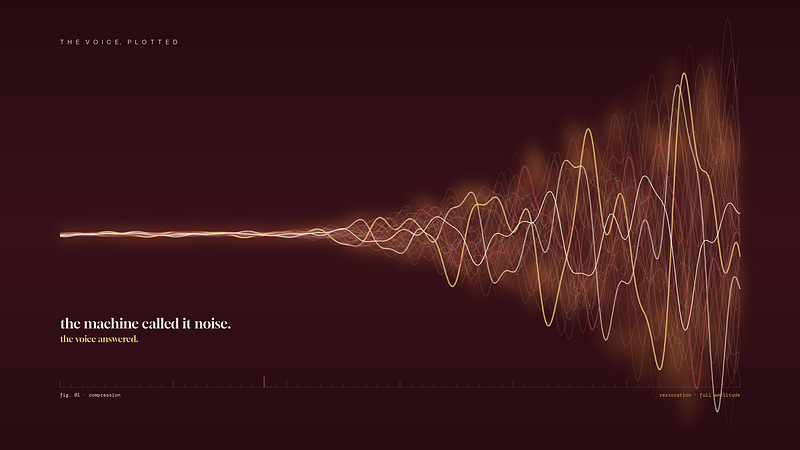
Here is the answer to the question in the subtitle, and I want you to hold onto it: AI changes how people sound because it is built to compress toward the average, and compression is not neutral. When the machine cleans up your words, it is making a decision about what counts as noise. For me, a technologist and author who trains agencies and government partners on enabling technology, AI implementation, and culturally adapted systems, that decision cost me flavor. For millions of other people, that same decision costs far more.
And this is not a one-time discovery I patched and moved past. It keeps happening, in real time. I have a native New Yorker accent, blended with a whole lot of culture, and the dictation tools I use every day misread me regularly, so I stay in the loop as the human intelligence, catching what the machine misheard. One day I was dictating and I recited a scripture, and Wispr Flow swapped the word for a different one. Fine, that happens, I corrected it. But then Perplexity Computer, which was organizing my journal entries, looked at my correction and told me the word could not possibly be what I meant. It must mean something else, it said, because my word did not make sense. I had to stop and tell the machine plainly: it does make sense, I was naming a scripture, it is applicable, do not change what I was saying.
Sit with what happened there. The machine did not just mishear me. It argued with my meaning. It looked at my faith, my culture, and my context, and decided its idea of sense outranked mine. And let me be clear about why I name these tools: I use them daily, by choice, because they are some of the best on the market. That is exactly the point. Even the best tools, in their default posture, will trust their training over your truth. The question is whether there is a human in the loop with the standing to say no. I have that standing. Now think about everybody who does not.
I was the best-case scenario, and it still lost me
Sit with that for a second. I have spent over three decades in disability and aging services. I am The Voice of Enabling Technology™. I wrote the book on tech equity. I serve as a subject matter expert on enabling technology and AI for government partners, concentrating on people with disabilities, mental health, and aging. I know how these systems are adopted, deployed, trusted, and misunderstood inside real human services systems. I know what they do well, and I know where they break, because I am standing there when they break.
And the machine still flattened me, because I trusted it while I was moving fast.
If it can do that to me, with everything I know, what is it doing to the woman with a developmental disability whose communication does not fit a clean script? What is it doing to the elder with Parkinson’s talking to the smart speaker that is supposed to keep her safe at home? What is it doing to the young man from Brooklyn speaking his cover letter into his phone, sounding exactly like where he comes from, which is to say sounding exactly like himself?
The research says this is not just my story
Let me name the lane before I show you the receipts. By culturally adapted AI, I mean AI that is configured around the person’s real context: their culture, disability, dialect, history, family language, communication style, and personal meaning. Not a generic user. A real person. Hold that definition while you read what the research found.
I was reading a study out of Cornell by Dhruv Agarwal, Mor Naaman, and Aditya Vashistha, presented at CHI 2025, where researchers watched what happened when people from different cultures wrote with AI suggestions turned on. The finding stopped me: AI suggestions led Indian participants to adopt Western writing styles, changing not just what was written but how it was written, homogenizing writing toward Western norms and diminishing the nuances that differentiate cultural expression (Agarwal, Naaman & Vashistha, CHI 2025). That is the academic language for what I saw on my two screens. The machine does not simply fix your typos. It pulls you toward a default voice, and the default voice was never yours. That is not a style problem. That is a culture problem.
Then there is the question of who the machine hears in the first place. I was reading the landmark study by Allison Koenecke, John Rickford, Dan Jurafsky, and their colleagues at Stanford, published in PNAS, which tested the speech recognition systems built by five of the biggest technology companies in the world. Every single one performed nearly twice as badly for Black speakers as for white speakers, with an average of 35 errors per hundred words for Black speakers against 19 for white speakers, and the worst performance of all for Black men (Koenecke et al., PNAS 2020). Think about what that number means in a world where speaking to a device is becoming how we bank, how we schedule care, how we document health visits, how we apply for jobs. That is not an accent problem. That is an access problem.
It gets heavier. Valentin Hofmann, Sharese King, and their colleagues published a study in Nature showing that large language models carry covert dialect prejudice: when people write in African American English, the models quietly associate them with less prestigious jobs and harsher judgments, holding stereotypes more negative than any human stereotypes ever experimentally recorded. And the standard safety training that companies apply does not fix it. It hides the racism on the surface while the deeper association stays intact (Hofmann et al., Nature 2024). So the person who speaks their truth into a device, trusting it to help them get a job or tell their story, may be getting quietly graded down for how they said it. Not what they said. How. That is not a grammar problem. That is a gatekeeping problem.
And for people with disabilities, the gap is not subtle at all. The Speech Accessibility Project at the University of Illinois documented that a speech recognition system with a 3.4 percent word error rate for typical speakers jumps to 36.3 percent for people with dysarthria, the kind of speech difference that comes with Parkinson’s, cerebral palsy, ALS, and other conditions (Speech Accessibility Project). One researcher on that project, Mark Hasegawa-Johnson, said the quiet part out loud: many people who need voice-controlled devices the most may encounter the most difficulty in using them well. In my field, that is not an inconvenience. That is a person’s remote supports, their medication reminders, their connection to the people who keep them safe, misfiring at the exact moment it matters. That is not a disability problem. That is a design problem.
The machine learned this from us
And before anybody reads this as a machine problem alone, let me be honest about where the machine learned it. Humans have been doing this to people the whole time. I have sat in more planning meetings than I can count, over three decades of them, and watched a member of the team decide they feel like the person should not do something, or translate what the person was clearly communicating into whatever the room already believed. The person says it plainly, in words, in behavior, in silence, and the meeting hears its own assumptions instead. We called it professional judgment. Sometimes it was. And sometimes it was just compression with a human face, the same move the machine makes, somebody deciding what counts as noise in another person’s life.
So no, AI did not invent misinterpretation. It inherited it from us, and then it scaled it. The difference is that a person in a meeting can be challenged in the moment. Somebody can lean forward and say, that is not what she said, ask her again. A default setting challenges nobody. It just runs. Which means the work in front of us is the same work it has always been, now with higher stakes: training people, and now systems, to hear the person instead of the assumption.
This is why I wrote about cultural adaptation in Tech Equity
None of this surprised me, and that is the part that should concern you. When I was writing Tech Equity: Freedom Through Enabling Technology, I made cultural adaptation a load-bearing wall of the book, not a paragraph, because I have lived what happens when technology is designed around a universal person who does not exist. That is why the book insists that technology must honor personal meaning over universal definitions, the idea I named the Dean Martin Principle™, because in care, a word can carry a whole lifetime that no generic model was trained to hear. And it is why my work now centers on what I call culturally adapted AI. When the fast rollout of AI leaves Black and Brown communities and people with disabilities out of the design and the training, the technology does not stay neutral. When the data cannot represent the needs of a culture or a disability, it can harm more than it helps.
My voice getting flattened inside my own filing system is the small, recoverable version of this. I caught it because I keep my original voice notes and I went back and listened. The person whose speech the system cannot parse, the applicant whose dialect the model quietly penalizes, the family whose way of communicating gets logged as noncompliance, they do not always get a receipt to check. The system just decides, politely and at scale, and the decision looks like neutrality.
The setup is the equity
So what do we do, since none of us is putting the technology down? I am certainly not. My entire body of work is built on the belief that technology, designed with humanity at the center, expands freedom. The answer is not less AI. The answer is that the prompting, the setup, the training, and the education around these tools have to be treated as equity infrastructure, not technical niceties.
When I work with my own tools now, I changed one thing that changed everything: I stopped letting the machine believe its job was to write, and I made its job to steward. My voice note is the draft. The instruction is to protect the length, the repetition, the asides, the culture, and to touch only what is broken. When the machine thinks it is the author, it flattens. When it knows it is the steward, the voice survives.
That same shift, scaled up, is the work I do in rooms across this field. When I am training agencies, big and small, on how technology, implemented correctly, becomes appropriate for people with disabilities and for seniors aging in place, this is the heart of what I teach: the technology and the human intelligence behind it have to work in sync, with a synergy about them, so the system keeps working for the person’s personalized, customized needs instead of drifting back toward the average. And when I sit with technology companies, the conversation flips but the principle holds. I help them see how a product built for one population can serve a population it was never designed around, and what it actually takes to integrate that product into the structures where care lives, home and community-based waiver services, assisted living, the family home, without losing the person in the translation. The companies bring the innovation. The field brings the funding streams, the regulations, and the lives. Somebody has to stand in the middle and make them understand each other, and I have made that middle my seat.
And leaders, here is your question. It is not “how fast can we adopt AI,” and hear me clearly, it is not “should we slow down” either. I want you to adopt. I build with this technology every day, and the organizations that wait will end up serving people with yesterday’s tools. The real question is whether the setup gets the same energy as the adoption. When this system compresses, who gets compressed? Ask it about your documentation tools, your hiring screens, your voice interfaces, your care platforms. Ask who the default settings were trained on, who on your team has been trained to configure them around real people, and who gets treated as the exception. Then fund the setup and the training with the same budget line and the same urgency as the rollout, because the people treated as exceptions are, in care and in life, so often the people with the most at stake.
I got my voice back because I kept the originals and I got angry enough to go look. My work now is making sure the people this technology was supposed to serve never lose theirs in the first place. Nobody could do me like me. And nobody can do them like them. The technology system has to be built to know the difference.
Precious “Preciosa” Myers-Brown (PMB) is the Dream Officer and architect of the Lifestyle of Innovation. At her core, she is in the business of becoming: showing people, and especially women stepping into their next chapter, that the best life is the one you build on your own terms and that reinvention has no expiration date. Everything she creates flows from that. She is a keynote and motivational speaker on innovation, leadership, and reinvention, the one leaders call when the vision is big and the execution has to match it. She is The Voice of Enabling Technology™ and the author of Tech Equity: Freedom Through Enabling Technology, and in 2006 she pioneered the first Remote Supports model for people with IDD in the District of Columbia, matching assistive technology to the whole person long before the field had a name for it. As the first Black woman to found and lead a full-service enabling technology company, she is founder and CEO of Vista Supports and House of CINO, advises the executives responsible for real care through CINO Vista, and builds the future-of-care workforce through WATI Institute, teaching, training, and moving others to build it too. She advocates for the people she believes in: folks with disabilities, seniors aging in place, and women over 50 who refuse to shrink. Through Healthy & Free with PMB she shares movement, body freedom, and fitness over 50 as the lived proof of her own transformation. As Steel Sugar, co-founder of Concrete Steppas™, she takes culture to the dance floor, and through Brown Sugar & Concrete she chronicles Black and Brown life, style, and diaspora. It all ladders to the freedoms she lives by: financial, location, flexibility, and fun. She will close the keynote and open the dance floor. Read Tech Equity: Freedom Through Enabling Technology and find everything at links.pmbofficial.com
Continue reading: Generic AI Will Not Save Care. It Might Erase the People Who Need It Most.